





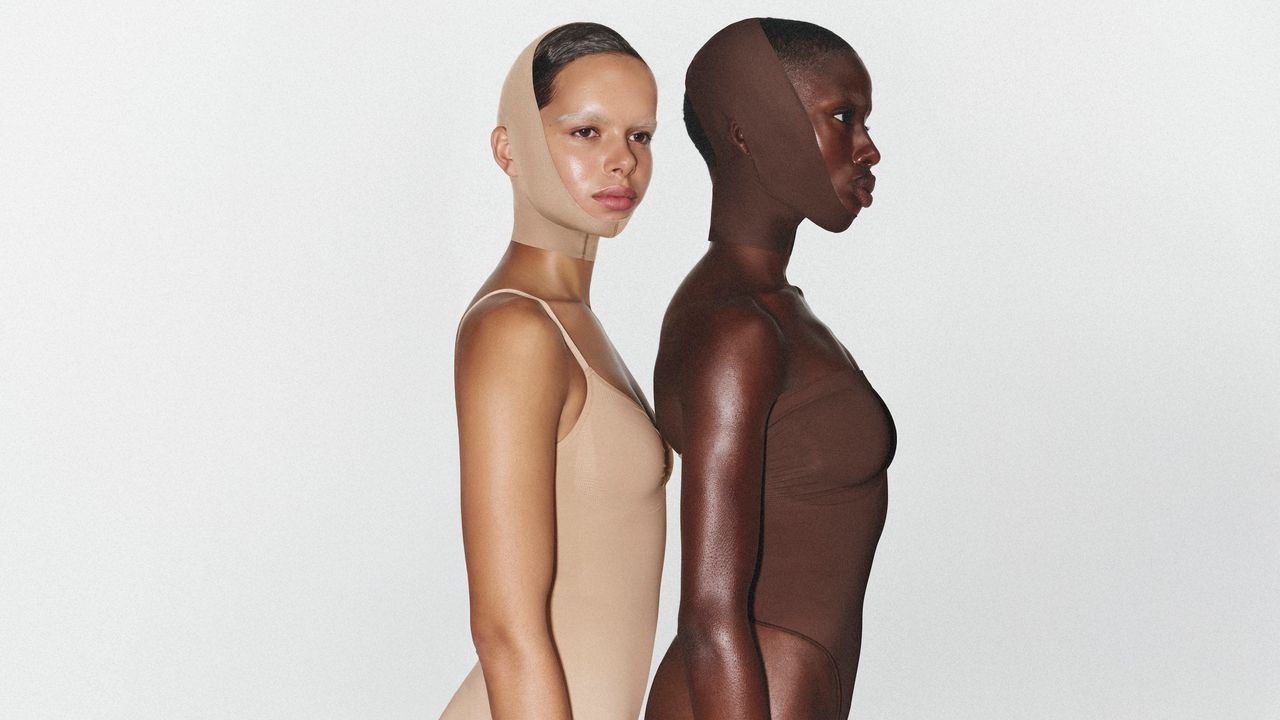
Upon seeing the new Skims facial shapewear, my initial reaction was skeptical. I couldn’t help but think, “How much more money does Kim Kardashian need?” The concept struck me as both bizarre and a bit desperate, as if the brand had decided to partake in a half-hearted April Fool’s prank. The Skims Seamless Sculpt Face Wrap is a rather peculiar garment—a large, flat piece of compressive fabric that snugly encircles the neck and chin, fastening at the top of the head with Velcro. The design even features small slits for ears, somewhat reminiscent of a character bandaged up in a horror film, like Tippi Hedren in “The Birds.”
Online, the reaction varied widely. While many people shared my bewilderment, comparing the face wrap to Hannibal Lecter’s infamous prison mask, others were surprisingly supportive. Some users reported that the face wrapping provided them with relief from puffiness and water retention, noting beneficial effects on their neck and jawline. This positive feedback, although in the minority, sparked curiosity and led me to reconsider my hasty judgment. It appeared that for some, this unconventional product actually served a purpose beyond mere aesthetics.
Despite the initial wave of criticism, I found it fascinating how this innovation highlighted broader societal attitudes toward beauty and self-image. There’s an entrenched pressure to conform to specific beauty standards, and Skims is tapping into that, albeit in an unconventional manner. While I questioned whether anyone genuinely needed such a product, it was clear that many individuals are eager to experiment with their appearance in ways that reflect both cultural shifts and personal aspirations.
As much as I leaned toward skepticism, I understood the desire for products that promise quick fixes. In an era dominated by social media, where filtered images often depict unattainable perfection, it’s no wonder that consumers might gravitate toward items that purport to enhance their features. Beyond mere vanity, the conversation around Skims’ face wrap underscores how deeply personal our relationships with our bodies and others’ perceptions can be. The emotional and psychological aspects tied to beauty standards cannot be ignored; they often drive us to seek out solutions, even those that seem outlandish.
Moreover, the dialogue surrounding the Skims face wrap raises essential questions about the role of celebrity influence on consumer behavior. Kim Kardashian, undeniably a cultural icon, carries significant weight in shaping trends. The backlash against the face wrap perhaps reflects not just a critique of the product itself but a larger disdain for what many perceive as the excessive commercialization of beauty. Are we being pushed to buy products that promise to make us look better, or are we genuinely in pursuit of self-improvement? These nuances complicate the narrative surrounding the item and the societal context in which it exists.
In conclusion, while I initially met the Skims Seamless Sculpt Face Wrap with skepticism, the conversation it sparked opened my eyes to the contradictory nature of beauty products in today’s society. They straddle the line between empowerment and absurdity, and while not every consumer will embrace such an item, it reveals an underlying truth about our quest for beauty. The mixed responses to Skims encapsulate the complex relationship we maintain with our appearances, reflecting insecurities that linger just beneath the surface—an ongoing dialogue that continues to shape our views on beauty and self-identity.