







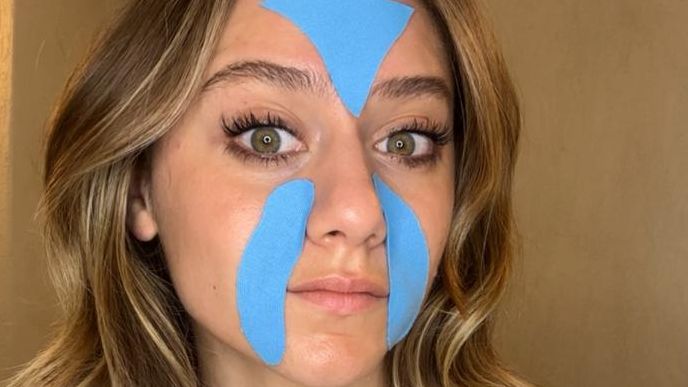
As night falls and your skincare routine reaches its climax, you’ve completed the essential steps: teeth brushed, skin cleansed, serum applied, and a good layer of moisturizer slathered on. But wait—did you remember the latest buzz in skincare? Enter face taping, a technique that’s gained traction thanks to celebrity facialist Guendalina Gennari, who has tended to the likes of Anne Hathaway and Rosie Huntington-Whiteley. Gennari swears by this innovative approach to combat fine lines and wrinkles, noting that as a side-sleeper, she would frequently awaken with pronounced creases on one side of her face. Taping, she claims, has made a significant difference. This revelation has certainly piqued the interest of many, particularly as the skincare industry has been flooded with products aimed at “eliminating” fine lines—a phrase that underscores our societal obsession with eternal youth.
The interest in face taping is emblematic of a greater cultural conversation about aging and beauty. In recent times, however, there’s been a welcome shift toward celebrating age and embracing natural beauty. Yet, despite this emerging age positivity, many still seek ways to maintain a youthful appearance, which is absolutely acceptable. The rising curiosity was evident when Google searches for “how to get rid of fine lines” surged by nearly 1,000% in just the past month, illustrating a persistent desire for solutions. While some may argue that we should embrace our wrinkles, the quest for fresh and youthful skin continues to captivate most beauty enthusiasts.
So, what exactly is face taping? This technique traces its origins back to the 1970s, when chiropractor Dr. Kenzo Kase introduced it in Japan primarily to support injured muscles and relieve pain. The concept involves using adhesive tape to modify muscle behavior—sometimes to enhance contraction or, conversely, to promote relaxation in specific areas. It’s also noted for boosting blood circulation during this time. Over the years, this technique has morphed into a skincare tool, with practitioners claiming it offers a variety of aesthetic benefits. Gennari highlights that while face taping isn’t a cure-all, it serves as a proactive measure to maintain skin structure, especially for people who sleep on their sides.
From a scientific standpoint, how does face taping work to mitigate fine lines? While dermatologists typically recommend introducing retinoids to elevate collagen production or opting for in-office treatments like laser therapy, Gennari posits face taping as an alternative methodology. According to her, regular application can help soften developing lines that arise from the natural shortening of muscles with age, creating unflattering creases. The tape acts as a supportive structure for facial muscles, which may help in delaying collagen degradation and its visible impacts on the skin. However, users should temper expectations; face taping isn’t a miracle solution for deep-set wrinkles but rather a preventive measure for those beginning to notice textural changes.
While the potential benefits of face taping sound promising, it’s essential to approach it with caution. Dr. Derrick Phillips, a consultant dermatologist, warns that face taping could have adverse effects, particularly concerning the skin barrier. The adhesive used in the tape has the potential to irritate the skin, leading to issues such as allergic reactions or breakouts. As with any skincare regimen, it’s crucial for individuals to conduct thorough research or consult with a dermatologist before diving into this trend. Those eager to explore face taping should consider experimenting with patch tests first to gauge how their skin reacts.
Adopting new skincare techniques requires an open mind and preparedness to tailor methods to individual needs. Face taping might appeal to those looking for a non-invasive option to keep fine lines at bay, but it should be part of a broader, more holistic skincare routine. Whether it’s through traditional methods like retinoids or groundbreaking techniques like face taping, the ultimate goal remains the same: to feel confident and comfortable in your skin, regardless of age. As society progresses toward a more positive approach to aging, it’s essential to balance the desire for youthful skin with a genuine appreciation for the stories our faces tell.